
The Hidden Skill Behind Erin Gregory's Abstract Florals
Most people assume that the more abstract your paintings become, the less your reference matters.
After all, if you're changing colors, simplifying shapes, and leaving details out, why spend time looking for the perfect photo?
Erin Gregory (Ep.90) takes almost the opposite approach.

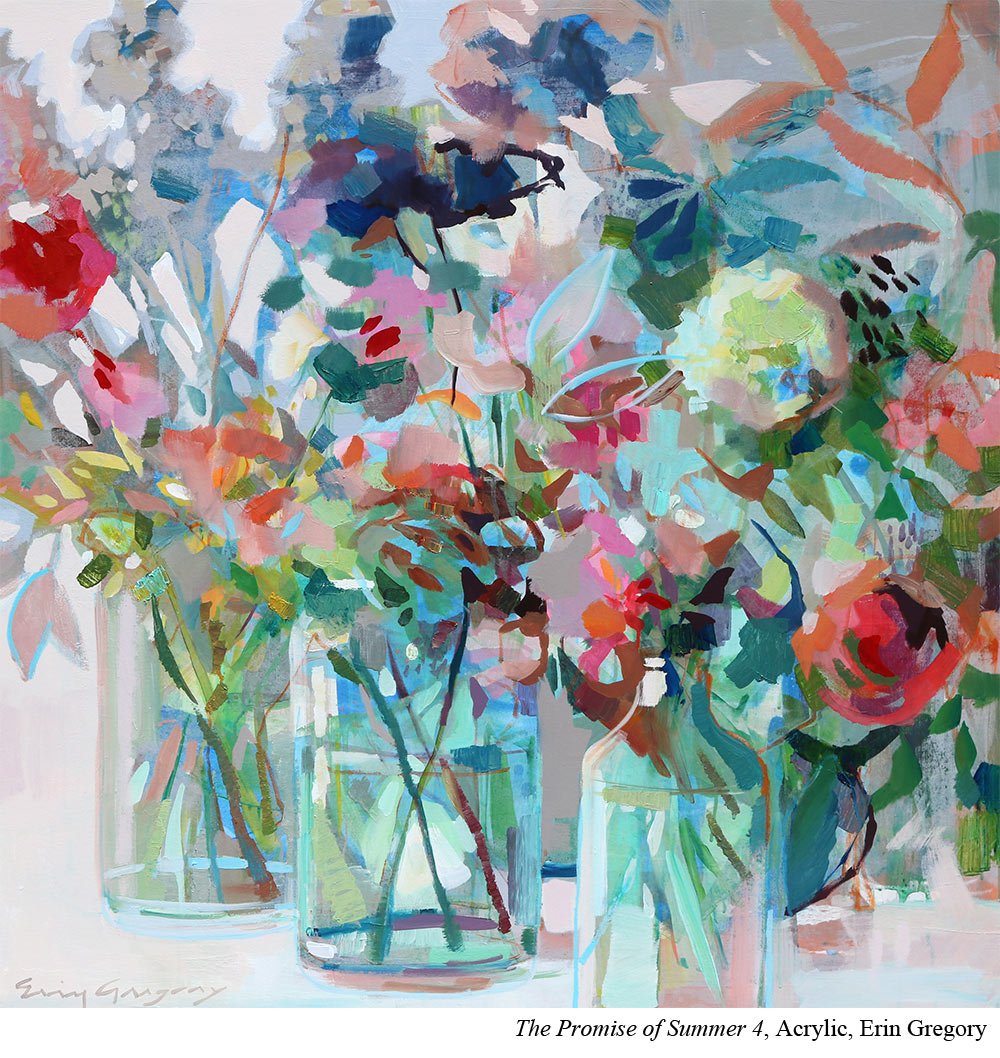
Gregory’s paintings are full of expressive color and abstraction. At first glance you might think her paintings are coming directly from her imagination.
But far from it. In fact not only does she work from reference photos but she’s incredibly selective in which she chooses.
Even though a huge portion of the flowers and colors will change from that reference, she still needs something only a reference can reliably give her: a strong sense of light and shadow.
Let's look at why.

Hidden Skill #1: Light Creates the Big Shapes
One of the biggest advantages of dramatic light is that it instantly simplifies a complicated scene.
Imagine looking at a giant bouquet filled with dahlias, roses, and dozens of other flowers.
With flat, even light, the bouquet becomes hundreds of shapes, both big and small. It can be tempting to treat every flower as its own separate shape, each with its own local color and value.
The problem is that this can quickly turn into a chaotic painting.
Now shine a strong light across that same bouquet.
Instead of seeing hundreds of unrelated shapes, you begin to see something much simpler: a light side and a shadow side.
Yes, there are still variations within those larger areas, but now the light becomes the thing organizing the painting rather than the local colors and values.
Flowers that might have felt like dozens of unrelated petals suddenly become grouped together inside larger light and shadow patterns.
Those larger shapes give Gregory much more freedom. She can suggest individual flowers, lose them completely, or abstract what's happening inside those shapes because the overall value pattern is already doing so much of the work.
That strong sense of light and shadow gives her much more room to play.

Hidden Skill #2: Light Creates Variety Without Losing Unity
One of the hardest balancing acts in painting is creating enough variety to keep things interesting without making everything feel disconnected.
Light naturally solves that problem.
Imagine a white tablecloth with red polka dots.
Without shadows, it's basically one repeated pattern.
Now let a shadow fall across part of the cloth.
Suddenly the white cloth becomes gray, and the bright red dots become a deeper shade of red.
Instantly, there's more variety.
But here's the added bonus. Everything still belongs together because it's simply a darker version of the same colors and patterns.
Light creates contrast, but it also creates relationships.
It does this on a tablecloth but it also does it with the leaves, petals, and stems that make up flowers.
Instead of having to force unity, Gregory lets the light establish it first.

Hidden Skill #3: Light Creates Realistic Anchors
Gregory's paintings are wonderfully abstract.
Whole sections of the bouquet shift in and out of recognizable flowers.
Edges disappear.
Sometimes a single line is enough to suggest an entire petal while everything else melts into the surrounding brushwork.
Underneath all of that abstraction is believable light.
Those consistent light and shadow relationships give your brain something familiar to grab onto. Even when the brushwork becomes loose, the values still describe convincing shapes.
Those realistic anchors allow Gregory to push abstraction much further without losing the subject entirely.
Ironically, realism is one of the things that makes the abstraction work.
Put It to Practice
If you're interested in painting more abstractly, don't toss your references.
Instead, look for references that are going to do a lot of the heavy lifting before you ever pick up a brush.
Look for a clear light source and strong shadows.
At first, you may not notice everything the light is doing. Your eye develops over time.
As you work with stronger references, you'll begin to see how light groups shapes together, creates natural variety, and builds believable shapes long before you start making artistic decisions.
The more abstract you want your paintings to become, the more important your reference- the right kind of reference- may actually be.