Inside Lynn Whipple’s High-Energy, Non-Precious Painting Process
You might hear a Lynn Whipple (Ep.23) class before you see it. Music. Laughter.
When you walk in, big canvases are rotating. Color is flying. Drawings go down and get wiped off just as quickly. Everyone is working fast. And Whipple is right in the middle of it all, dancing.

“We stand up. We’ve got music playing,” Whipple says of her live classes. “Sometimes we’ll break into dance. There’s silliness. It takes the seriousness out of it, even though I’m teaching some serious principles. I want people to feel free to make mistakes.”
Spend time talking with Whipple, a Florida-based artist, and you’ll find many of these same elements in her own studio practice. Music. Laughter. Joy.
“I just don’t care,” she says about being labeled as serious. “If you’re having fun and you’re alive and you’re making stuff, that’s what matters.”
THE EARLY MIXED MEDIA LIFE
Whipple has always been a collager.
As a child, a large bulletin board was the center of her universe. She collected everything. She laid it out. She moved it around. She painted leaves, rocks, and paper scraps, experimenting with what happened when things were placed together.
Later, while working in the art department at Nickelodeon, she found new materials the same way: by paying attention to what was available. She pulled flats from the studio trash, large narrow wooden boxes once used as set walls, and brought them home to use as giant painting surfaces.
“If you’re having fun and you’re alive and you’re making stuff, then that’s so much more important.”
— Lynn Whipple
Today, what ends up in a painting may be as simple as what happens to be on her work table when she starts.
“If you're having fun and you're alive, and you're making stuff, then that's so much more important.”
-Lynn Whipple

THE POWER OF ABUNDANCE
From backyard rocks to sheets of lumber, Whipple’s process has always been rooted in abundance. She works with multiple boards at once and surrounds herself with paint. A lot of paint.
A big part of the pleasure is having options and not worrying about running out.
That’s why her first paint was house paint. She already knew it from her set-painting days, and it offered something she needed as a learner.
“It was abundant. Not precious,” she says. “There was a lot of freedom in that.”
Whipple loved that house paint was matte and easy to draw on. More importantly, it gave her room to learn color.
“When I was learning, the freedom of choosing all my colors mattered,” she says. “I liked that red, and it already existed in this wide-mouth jar. It wasn’t precious. I wasn’t thinking, ‘That’s expensive.’ That beginning helped me understand color, play with color, and not worry about wasting it.”
Today, she uses artist-quality paint for archival reasons. But she still protects that same feeling of abundance. When she starts a new project, she makes sure she has plenty of materials within reach.
For example, when she began working in non-objective painting, she bought large amounts of gouache.
“I buy like a million art supplies,” she says. “It’s so bad. But it’s so good. I can experiment all the time.”
AVOIDING PRECIOUSNESS
Abundance serves a purpose. Whipple uses it to guard against preciousness.
In her experience, preciousness is the enemy of experimentation, loose painting, and learning.
She designs her workshops the same way she designs her studio practice.
“There’s so much paint,” she says of her classes. “So many gorgeous flowers. We want it to feel like a candy store. Let’s try. Let’s experiment.”
She also uses speed.
“I constantly say, ‘This is going to change. Don’t fall in love with it. We’re going to spin the canvas.’ I keep people just off balance enough that they stay in the moment. That’s what helps them paint big.”
This mirrors how Whipple works herself.
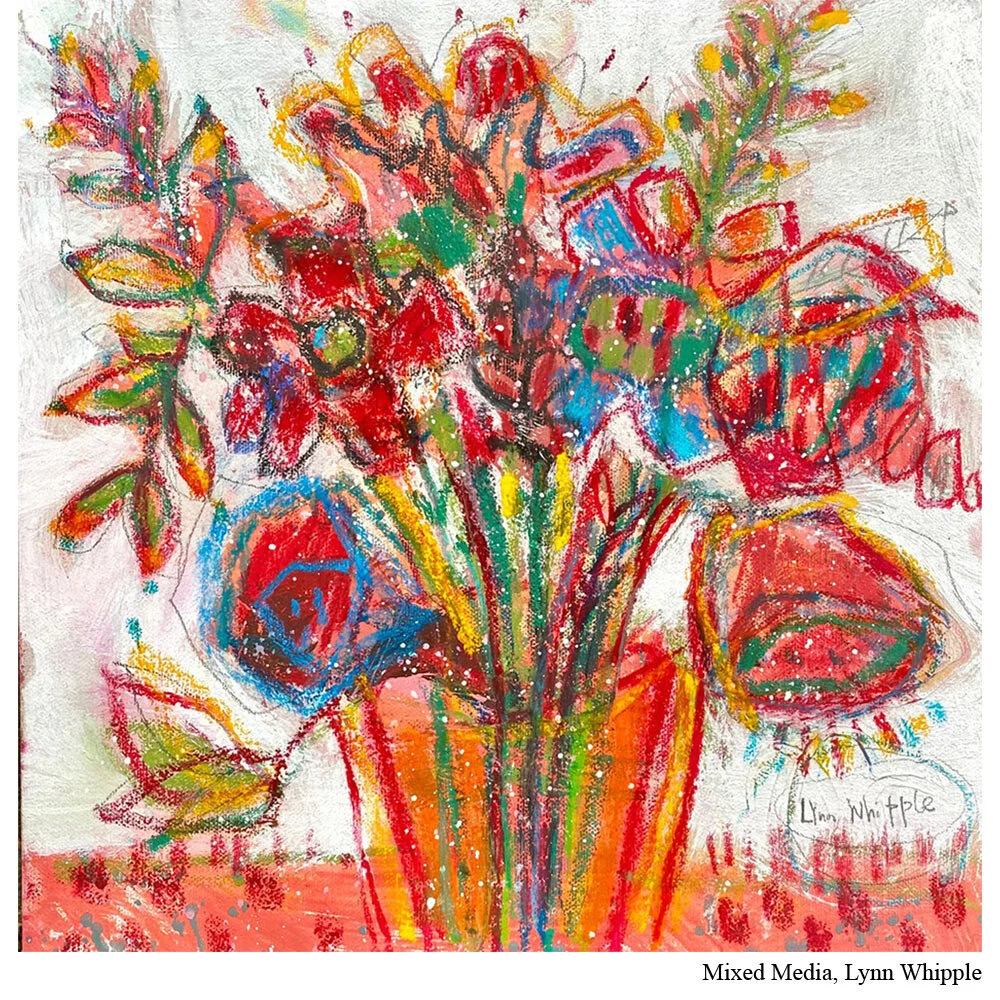
She begins with loose underlayers. She draws with charcoal and wipes it out. She rotates the canvas between rounds so unexpected shapes can emerge. She pushes complementary colors, builds energy, then brings the painting together with a final background and line work in pastel and pencil.
The unpredictability that keeps her students moving forward is the same unpredictability she relies on in her own work.
Over time, Whipple has built a process she truly loves. And she believes that discovery matters more than any particular technique.
“You have to make it fun for yourself,” she says.
That looks different for every artist. Some want to move, dance, and use their whole body to paint.
If that’s you, go big. Go messy. Use a lot of paint.
But maybe the opposite is true.
“Are you super happy with just you and your tiny, beautiful dip pen?” Whipple asks. “Then do that. Do the thing that makes you light up.”
“So it takes all that seriousness out of it though I'm teaching some serious principles ...But I do like for people to feel free to make mistakes,” Lynn Whipple

PUT IT TO PRACTICE
If preciousness is getting in the way of your painting, redesign your process to make it harder to protect everything.
Start with abundance. Put out more materials than you think you need. Extra paper. Extra boards. More paint than feels reasonable. The goal is not efficiency. The goal is removing the pressure of “don’t waste this.”
Next, introduce change. Set a short timer. Rotate your surface. Wipe something out halfway through. Say it out loud if you need to: This is going to change.
Then choose non-precious actions. Use a tool you’re less attached to. Draw into wet paint. Paint over something you like. Let parts of the process be temporary on purpose.
Finally, pay attention to what actually feels fun. Not what you think should feel fun. Music or silence. Big gestures or tiny marks. Standing up or sitting down with a dip pen.
There’s no correct answer.
The only useful question is this:
What helps me stay loose enough to keep going?
Build your process around that.
Get articles like this and new podcast episodes sent straight to your inbox by signing up for the newsletter below.