When Your Painting Fails, This Is What Comes Next
When artist Dean Mitchell (Ep.30) starts a painting, he goes all in. No hesitation. He works fast, drops in paint, lets it drip, and makes decisions on the move.
And because he paints that way, sometimes things go sideways.
But Mitchell doesn’t treat those paintings as proof that he’s not good enough. He doesn’t treat them as a waste, either. He treats them as something useful.
He treats them as information.

When a painting “fails,” he starts over
Mitchell has watched students approach watercolor like it’s fragile. They get timid. They try to protect the paper.
His response is blunt: you can always start over.
He knows first hand the frustration of putting your all into a piece… only to have it go sideways 3/4ths of the way through.
Frustrating? Yes. But not final. Because after all, you can choose to start again. And Mitchell often does.
The artist has learned first hand that a mistake doesn’t end the session. It just ends that attempt.
He knows early when it’s not working
Mitchell can tell, sometimes within a few strokes if the painting is going to work.
He doesn’t get punitive about it.
It’s less “I hate this and am quitting" and more “This past isn’t it.”
So he stops. He grabs another piece of paper. He starts over.
This is where most painters spiral. When you’ve already invested time, you feel like you have to rescue it. You feel like you need to fix it to justify the effort.
Mitchell does the opposite. He doesn’t rescue. He starts again.

The “failed” one becomes a study
Here’s the mindset shift that changes everything: the abandoned or “mistaken” work doesn’t get thrown away.
It becomes a study.
Mitchell says that even when he restarts, that first attempt becomes part of the process. It’s not a lost cause. It’s now a reference. It sits right next to him while he paints the next version.
He can pull something from it. Maybe it’s an edge. A value relationship. A wash that surprised him. A shape that worked. Or even a reminder of what was too wet, too dark, or pushed too far.
That is the real mental shift:
A failed painting is something you see as a mistake.
A study is something see as a tool.
And that single word change turns frustration into forward momentum.
“It’s information”
Mitchell uses that word directly: information.
Sometimes an area works beautifully and another area doesn’t. He can often remember what happened, even when the process is intuitive. Too wet here. Too dark there. The paint moved in a way he didn’t account for. He didn’t blot soon enough. He lifted a layer when he shouldn’t have.
That information is fresh. Usable. It teaches him what to do next while the lesson still has heat.
This is why restarting doesn’t set him back. It’s just part of how he moves forward.
Bold work requires risk
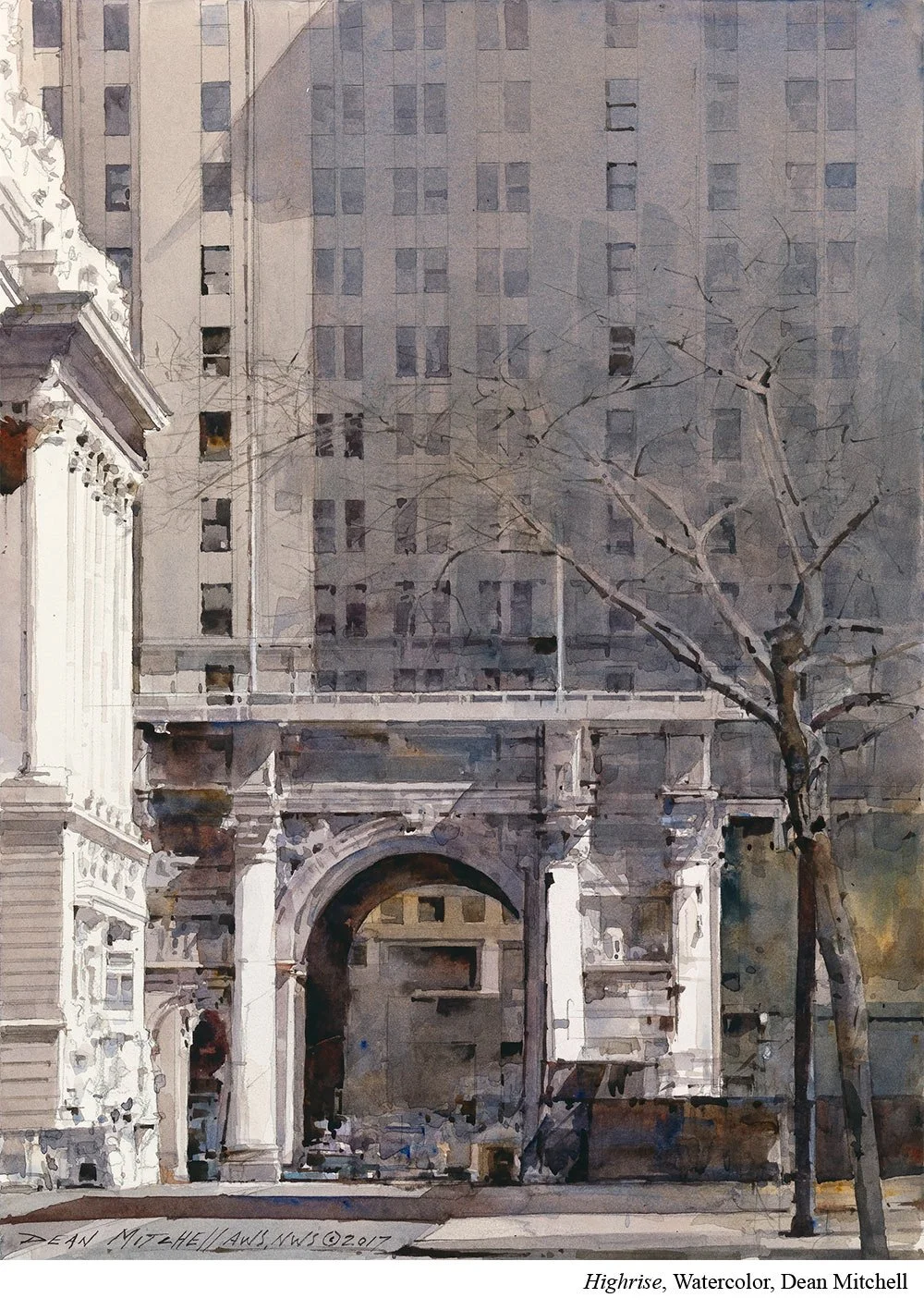
Mitchell’s watercolor approach is physical and intuitive. He’s not trying to control every molecule of water. He’s letting the medium move, then responding.
This is in large part because as a medium, watercolor can’t be totally controlled. At least not in the way Mitchell wants to paint. And so part of learning watercolor is learning how to let it go.
He’s learned that through thousands of experiments. In fact, constant experimentation is at the heart of his approach.
He experimented when he was learning the medium, not by trying to make masterpieces, but by playing with paint to see what it could do. Over time, that experimentation made him more daring, more intuitive, and more willing to move forward even when he didn’t know exactly how it would turn out.

Put it to Practice
You can take Mitchell’s approach and fold it directly into your own painting process.
First, experiment so you understand the medium.
Don’t ask every session to produce a polished, finished piece. Let yourself experiment. Follow what the paint does. Notice what surprises you. Look for information, not judgment.
Next, paint boldly and learn from it.
Painting boldly will almost guarantee that some things won’t work right away. That’s not a problem. That's the point. Bold skills are built by actually taking bold actions, not by playing it safe.
Restart quickly when it goes wrong.
You don’t need to fix everything. If something starts to fall apart, give yourself permission to stop and begin again. Practice noticing, without judgment, when things have gone sideways and try again.
Use the “mistake” as a study so it still moves you forward.
When you restart, don’t change the subject, the reference, or the medium. Stick with the same problem you were trying to solve. Use what you learned from the first (or second or third) attempt and apply it immediately.
That’s how failed paintings turn into momentum. Not by avoiding them, but by using them to become a better painter.